Your Trees Are a Line Item: How Species Choice and Placement Shape What Gulf Coast Homeowners Pay for Insurance
Photo: N Chadwick , CC BY-SA 2.0, via Wikimedia Commons
When Gulf Coast homeowners review their insurance declarations pages, they scrutinize the dwelling coverage, the deductible, the wind policy. Almost nobody thinks about the water oak leaning over the guest bedroom. Their insurance company does.
Insurers in hurricane-prone regions price risk in detail, and trees factor into that calculation more than most policyholders realize. The species you plant, where you plant it, and how well you maintain it all shape how an underwriter — and, after a storm, a claims adjuster — views your property.
The Species That Raise Red Flags
Certain trees are, from an underwriting standpoint, liabilities with leaves. The common thread is fast growth paired with weak wood and shallow roots — a combination that performs badly in Mobile's tropical storms and hurricane-force gusts.
1. Water oak. Ubiquitous across Mobile's older neighborhoods, water oaks grow quickly and decay quickly. By forty or fifty years, many are hollow-core hazards, and they are among the first species to fail in summer thunderstorms.
2. Bradford and ornamental pears. Prized for spring blooms, these trees have branching architecture that practically invites splitting. A single ice event or strong squall line can shear them in half.
3. Silver maple. Fast-growing and brittle-wooded, silver maples drop limbs with little provocation and push aggressive roots toward foundations and sewer lines.
4. Weeping willow. Beautiful near water, disastrous near structures. Willows are prone to limb breakage and their water-seeking roots invade drains and pipes.
5. Chinaberry and other volunteer species. Weak wood, invasive tendencies, and short lifespans make these common volunteers a recurring claims expense.
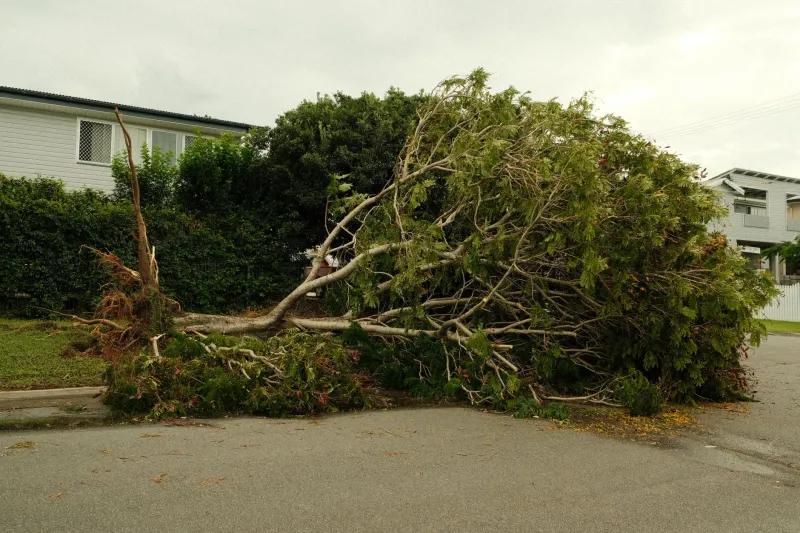
A mature specimen of any of these species overhanging a roofline is exactly the kind of detail that shows up in an insurer's risk notes — or in a denied claim after a limb goes through shingles during a named storm.
Species That Strengthen Your Position
On the other side of the ledger are trees whose structure and storm record earn them a place near Gulf Coast homes. Slower growth generally means denser wood and better branch attachment.
1. Southern live oak. The icon of the Gulf Coast for good reason. Properly spaced and pruned, live oaks are among the most wind-resistant large trees available to Mobile property owners.
2. Southern magnolia. Dense, evergreen, and structurally sound, magnolias handle coastal wind exceptionally well.
3. Bald cypress. Tolerant of wet soil — a genuine advantage in Mobile's low-lying areas — and remarkably windfirm.
4. Crepe myrtle. Small stature means limited consequence when damage occurs, making it a low-risk ornamental near structures.
5. Dahoon holly and other small natives. Modest canopy, strong wood, and storm tolerance make hollies a dependable choice for close-to-home planting.
Placement matters as much as species. A wind-resistant tree planted with mature canopy clearance from the roof, and away from power lines and driveways, contributes far less risk than a poorly sited specimen of the same species.
Documentation: The Overlooked Claim Asset
After a storm, the burden of demonstrating that a tree was healthy and maintained falls on the homeowner. A large limb from a neglected, decay-filled tree that strikes a house invites tough questions from the adjuster; the same limb from a professionally maintained tree with a documented care history tells a very different story.
Homeowners who keep records of routine pruning, arborist inspections, and hazard mitigation work are far better positioned when a claim is filed. In some cases, insurers look more favorably on properties where hazardous trees have been proactively removed — evidence that the owner manages risk rather than waiting for the wind to do it.
If you are unsure which trees on your property fall into which category, a professional tree risk assessment provides an objective, written evaluation you can share with both your insurer and your contractor.
Landscaping as Risk Management
The trees you plant today are the premiums and claims of the next twenty years. Before adding to your landscape — or before a renewal conversation with your agent — consider how your current trees would read on a risk report. Choosing storm-resistant species, siting them with mature size in mind, and investing in documented professional care turns your landscape from a hidden liability into an asset that stands up to the Gulf Coast weather we all know is coming.