Strangers in the Canopy: Recognizing and Removing Invasive Tree Species Before They Reshape Mobile's Landscape
When a Tree Is Not Welcome
Not every tree that takes root in a Mobile yard belongs there. Some species arrive as ornamental plantings that eventually escape cultivation. Others hitchhike in on wind currents, wildlife, or contaminated soil. Once established, invasive tree species can spread with remarkable efficiency, crowding out the native oaks, magnolias, and cypresses that have defined the Gulf Coast landscape for centuries.
The consequences extend well beyond aesthetics. Invasive trees alter soil chemistry, disrupt local wildlife habitat, and in some cases increase fire risk or introduce new pest pressures. For homeowners, they can also create structural hazards, interfere with utility lines, and complicate property maintenance in ways that compound over time.
Understanding which species pose the greatest threat — and how to recognize them — is the first step toward protecting your property and your neighborhood.
The Most Problematic Invasive Trees in Mobile and the Gulf Coast
Chinese Tallow (Triadica sebifera)
Few invasive trees have proven as aggressive in the Gulf South as Chinese tallow. Originally introduced from East Asia as an ornamental and potential biodiesel crop, this fast-growing deciduous tree now dominates disturbed soils, wetland edges, and roadsides throughout coastal Alabama and Mississippi.
Chinese tallow is identifiable by its heart-shaped leaves with long, tapered tips, its distinctive waxy white seed clusters that persist through winter, and its tendency to form dense thickets in disturbed areas. The tree leafs out early in spring and holds its foliage late into autumn, giving it a competitive edge over native species in terms of light capture.
One of the more insidious qualities of Chinese tallow is that it produces allelopathic compounds — chemicals that suppress the germination and growth of surrounding vegetation. A single mature specimen can generate thousands of viable seeds annually, and birds readily distribute them across wide areas.
Chinaberry (Melia azedarach)
Chinaberry has been present in the American South long enough that many residents mistake it for a native species. Its clusters of fragrant purple flowers in spring and persistent yellow berries in autumn give it a deceptively ornamental appearance. However, all parts of the plant are toxic to humans and most livestock, and the berries are consumed and dispersed by birds, enabling rapid colonization of fence rows, woodland margins, and disturbed lots.
Chinaberry grows quickly, tolerates poor soils, and regenerates aggressively from its root system after cutting — characteristics that make casual removal efforts largely ineffective without follow-up treatment.
Mimosa (Albizia julibrissin)
The mimosa tree, with its feathery compound leaves and pink powder-puff blossoms, has long been a sentimental fixture in Southern gardens. That familiarity, unfortunately, has obscured its invasive status. Mimosa spreads prolifically along roadsides, stream banks, and forest edges throughout Alabama, and its nitrogen-fixing root system can alter soil conditions in ways that favor its own continued spread over native understory plants.
Seed pods are produced in large quantities and remain viable in the soil for years, meaning that even after a mature specimen is removed, seedlings may continue to emerge for an extended period.
Empress Tree (Paulownia tomentosa)
Less common than the species above but increasingly observed in parts of coastal Alabama, the empress tree is notable for its extraordinary growth rate — sometimes exceeding six feet per year — and its ability to colonize disturbed sites, including post-storm debris zones. Its large, heart-shaped leaves and clusters of violet flowers make it visually striking, but it spreads aggressively from both seed and root sprouts, and its canopy density can significantly suppress native regeneration beneath it.
Why Native Trees Lose This Competition
Native species in Mobile's urban and suburban canopy — live oaks, water oaks, sweetgums, bald cypresses, and Southern magnolias, among others — evolved in balance with local soils, climate patterns, insects, and wildlife. Invasive trees, by contrast, arrive without the natural checks that limit their populations in their countries of origin. No local pathogens, no specialized herbivores, no competition from co-evolved plant communities.
The result is an uneven playing field. Invasive species grow faster, seed more prolifically, and tolerate a wider range of conditions. Native trees, already under pressure from urban heat, soil compaction, and altered hydrology, struggle to compete when invasive neighbors are drawing down light, water, and nutrients simultaneously.
How to Identify a Potential Invasive on Your Property
Homeowners are not expected to carry field guides, but a few practical habits can help flag suspicious specimens for professional evaluation.
Observe the growth rate. Trees that seem to appear and reach significant size within a single growing season warrant attention. Most native species in Mobile grow at moderate rates.
Look at seed and fruit production. Invasive trees tend to produce abundant fruit or seed clusters, often consumed by birds. Large quantities of seedlings appearing beneath or around a tree are a signal worth investigating.
Note the location. Invasive species frequently appear first along disturbed margins — fence lines, drainage channels, recently cleared lots, and post-storm areas where native vegetation has been removed or damaged.
Examine the leaf structure. Many common invasive trees in the Gulf South have compound or distinctively shaped leaves that differ from native species. If a tree in your yard doesn't match any species you recognize, a certified arborist can provide a definitive identification.
Removal Is More Complicated Than It Appears
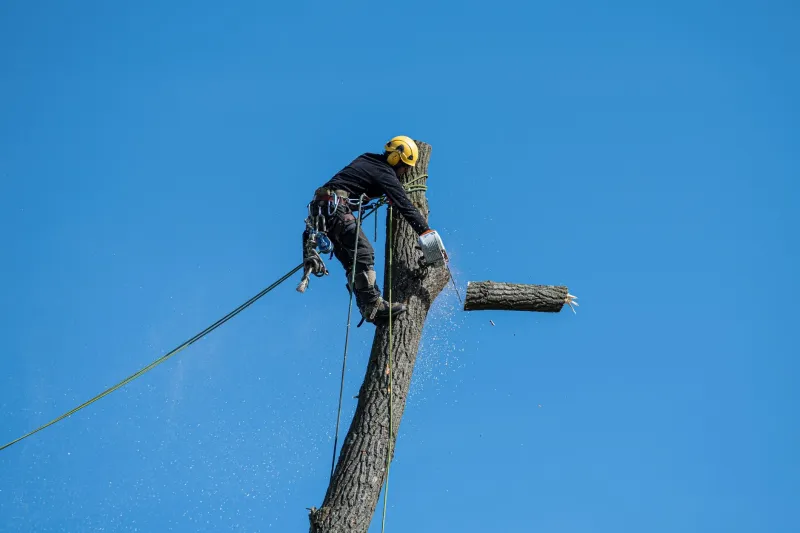
Cutting an invasive tree at the base is rarely sufficient. Species such as chinaberry and mimosa resprout vigorously from root crowns and stumps, often producing multiple stems where one previously stood. Effective removal typically requires a combination of mechanical removal and targeted herbicide application to the cut surface or root system — work that demands professional knowledge of both the species and the appropriate treatment protocols.
Improper removal can also accelerate seed dispersal. Cutting a Chinese tallow in fruit, for example, may scatter seeds across a wider area than would otherwise occur. Timing and technique matter considerably.
The Role of the Arborist in Protecting Mobile's Native Canopy
Certified arborists working in the Mobile area occupy a unique position in this challenge. In the course of routine inspections, pruning appointments, and post-storm assessments, they encounter properties across the full spectrum of the urban and suburban landscape. That visibility allows them to identify invasive species in early stages of establishment, before removal becomes a significant undertaking.
At Mobile Arborist Co., our assessments routinely include an evaluation of species composition on a property, not only for structural risk but for ecological compatibility. When invasive specimens are identified, we provide removal recommendations scaled to the situation — whether that means a straightforward extraction or a multi-visit treatment plan for species with persistent root systems.
What Homeowners Can Do Now
Prevention remains the most effective strategy. Selecting native or regionally appropriate species for new plantings reduces the likelihood of inadvertently introducing invasive material. Consulting with a certified arborist before planting any unfamiliar species — particularly fast-growing ornamentals — is a reasonable precaution that can prevent significant problems down the line.
For properties where invasive trees are already established, early action is far less costly than delayed management. A single Chinese tallow removed before it reaches seed-bearing maturity represents a fraction of the effort required to address a mature specimen surrounded by seedling offspring.
Mobile's canopy is a defining feature of this city — one worth defending with informed, professional attention. Invasive species represent a slow but measurable threat to that legacy, and addressing them is as much a matter of responsible land stewardship as it is practical property management.