What Your Trees Are Quietly Telling You: A Practical Guide to Spotting Decline Before Crisis Strikes
Most trees do not fail without warning. Long before a branch crashes through a roof or a trunk splits under wind pressure, the tree has been communicating its distress in ways that are easy to overlook — unless you know precisely what to look for. In Mobile, Alabama, where heat, humidity, saturated soils, and seasonal storms conspire against even well-established specimens, the window between early decline and genuine hazard can close faster than property owners expect.
Recognizing the difference between a tree experiencing temporary environmental stress and one progressing toward structural failure is not a matter of guesswork. It is a matter of systematic observation, informed by an understanding of how trees respond to injury, disease, and root compromise over time. What follows is a practical guide to the warning signs that certified arborists in Mobile evaluate during routine inspections — and why catching these signals early is almost always less expensive than responding to a crisis.
Canopy Thinning: Not All Leaf Loss Is Equal
Seasonal leaf drop is a natural part of a tree's annual cycle. Gradual, progressive canopy thinning — particularly when it does not follow expected seasonal patterns — is something else entirely.
A declining tree often begins to shed density from the outermost tips of its branches inward, a pattern arborists refer to as dieback progression. This is distinct from the uniform thinning that might follow a drought or a particularly harsh summer. When branch tips die back progressively over successive growing seasons, the tree is typically allocating diminishing resources to its most distal growth, prioritizing core survival over canopy extension.
In Mobile's climate, this pattern frequently signals root compromise — whether from soil compaction, fungal infection at the root collar, or chronic waterlogging in low-drainage areas. Pay close attention to whether dieback is isolated to one side of the canopy, which may indicate directional root loss, utility damage, or a localized soil chemistry problem that warrants immediate investigation.
Bark Changes That Signal Internal Trouble
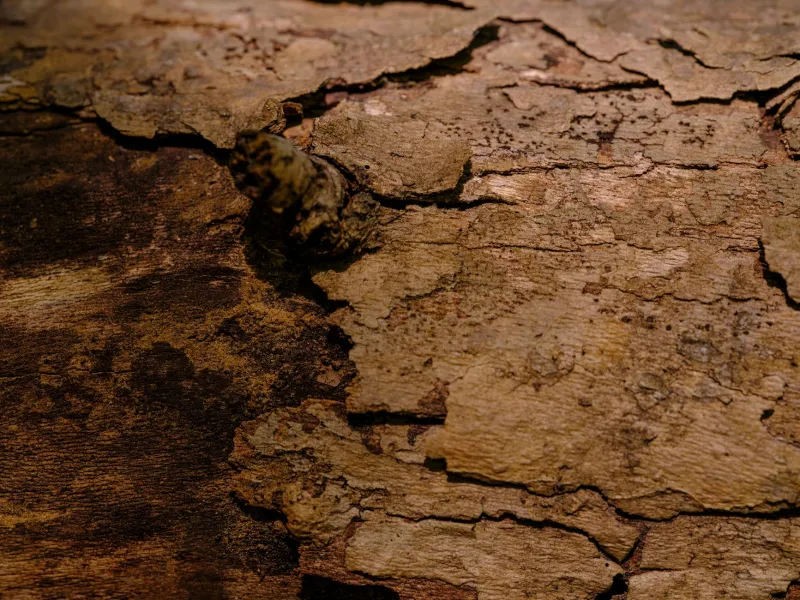
Healthy bark is more than a protective exterior. It is a living record of what is happening beneath the surface. Discoloration, cracking, peeling, or the sudden appearance of fungal conks along the trunk or at the base of the tree are among the most reliable external indicators of internal decay.
In Mobile's warm, humid environment, wood decay fungi find ideal conditions year-round. Bracket fungi — those shelf-like growths that emerge from trunk wounds or root flares — indicate active decomposition of interior wood. By the time these structures become visible externally, the decay process has often been underway for years. Their presence does not automatically mean the tree must be removed, but it does mean the tree requires professional structural assessment without delay.
Less obvious bark signals include vertical cracks running along the trunk, areas where bark has separated from the wood beneath (a condition sometimes called sloughing), and localized areas of discoloration or dampness that suggest bacterial wetwood or canker disease. Any of these warrant attention before the next storm season.
Root Zone Clues That Most Homeowners Miss
The root zone is where many decline stories begin, yet it is the area property owners are least likely to examine. In Mobile's older neighborhoods, where sidewalks, driveways, and compacted clay soils restrict root development, trees often struggle silently for years before surface symptoms become visible.
Look for soil heaving or cracking near the base of the tree, which may indicate root girdling or fungal activity at depth. Mushroom clusters emerging from the soil within the drip line — the area beneath the outer edge of the canopy — are a reliable indicator of root decay. Epicormic sprouting, the sudden appearance of clusters of small shoots emerging directly from the trunk or major limbs, is another sign that a tree is under significant stress and attempting to compensate for reduced canopy function.
Changes in soil drainage patterns around a tree's base can also be revealing. If an area that previously drained adequately now holds water after rainfall, root death may have reduced the tree's capacity to absorb moisture — a feedback loop that accelerates further decline.
Branch Structure and Attachment Angles
Beyond visible decay and canopy changes, the structural geometry of a tree's branching pattern carries important information about long-term failure risk. Included bark — the condition that develops when two co-dominant stems grow at narrow angles and bark becomes embedded between them — creates a structurally weak union that is prone to splitting under load. This is particularly relevant for Mobile's live oaks and water oaks, which frequently develop competing leaders if not properly trained during their early years.
Cracks at branch unions, excessive end-weight on long lateral limbs, and the presence of previously failed branches that were never properly addressed are all structural risk factors that compound over time. A single compromised union may be manageable. Multiple structural defects in combination — especially when layered atop root compromise or internal decay — create a risk profile that warrants professional evaluation.
Why Routine Inspections Are the Most Cost-Effective Tree Care Strategy
There is a straightforward financial logic to routine arborist inspections that is easy to articulate: the cost of identifying and addressing a problem in its early stages is almost always a fraction of the cost of emergency removal, property repair, or liability exposure after a failure event.
In Mobile, where hurricane season runs from June through November and summer storms can arrive with limited warning, trees that have been quietly declining for years become high-consequence hazards during the exact periods when emergency tree services are most in demand — and most expensive.
A certified arborist assessing a tree during a routine inspection brings a systematic framework to the evaluation: crown structure, bark condition, root zone health, soil profile, and historical context all factor into a risk assessment that goes well beyond what a homeowner can reasonably observe from the ground. When early intervention is warranted — whether through targeted pruning, soil remediation, cabling, or treatment for a specific pathogen — the investment is modest compared to the alternative.
Trees are long-term assets. In Mobile's landscape, where mature live oaks and established hardwoods contribute meaningfully to property value, neighborhood character, and quality of life, treating their care as an afterthought carries real costs. The signs of decline are usually visible long before the emergency. The question is whether anyone is looking.